Teaching
More Information
- Dr. Paul Wiegert
- Physics and Astronomy 238
- Phone:(519) 661-2111 x 81327
- email:pwiegert {at} uwo.ca



Asteroid encounters with 99942 Apophis(4-Mar-2024) Asteroid 99942 Apophis is a 370 meter diameter object on course to miss our planet by a safe margin in 2029. However, that could change in the highly unlikely case that Apophis collides with another asteroid in the mean time. This risk is extremely small but to quantify it, we identified close encounters between known asteroids and Apophis. We show that the 1300 meter (0.8 mile) diameter asteroid 4544 Xanthus will miss Apophis by 500,000 km in December 2026. Their Minimum Orbit Intersection Distance (MOID) is less than 10,000 km, with Xanthus passing that point just four hours after Apophis. We also identified other asteroid encounters of interest in a peer-reviewed report accepted by the Planetary Science Journal. Click here for more information, including a link to our paper. Click the animation to the left for a larger version on YouTube. |
|
How the first quasi-moon got its name..."Zoozve"(26-Jan-2024) Ok, this is only partly my research but too interesting not have here. Check out Radiolab's podcast about asteroid 2002 VE68, the first known "quasi-moon" and how an improbable chain of events lead to its being named "Zoozve". Click on the left or here for a larger view of the animation on Youtube, which shows Zoozve's path within our Solar System. Check out my own "its-so-old-its-almost-retro" page on quasi-satellites (quasi-moons and quasi-satellites are the same thing). |
|
An unexpected visitor from the outer limits(12-Dec-2022) In our Solar System, icy material is thought to originate far from the Sun, where it's cold. Rocky ice-free material should come from the regions much closer to the Sun. However, a rocky meteoroid observed over Alberta Canada in 2021 arrived from our planetary system's outermost edge. The significance of this unusual rock from the icy Oort Cloud is discussed in Vida et al. (2022) published in the December 12 2022 issue of Nature Astronomy. Click the animation to the left for a larger version on YouTube, or check out our paper at Nature Astronomy. |
|
Asteroid 2022 WJ1 impacts Canada(19-Nov-2022) Asteroid 2022 WJ1 was first spotted by the Catalina Sky Survey in Arizona, when the approaching one-meter diameter asteroid was only hours from striking Earth. Once it struck the top of our atmosphere, the asteroid became a fireball, flashing across the skies of Southern Ontario at 3:26 am local time. Residents along the Lake Ontario shoreline from Grimsby to Niagara-on-the-Lake Ontario should check their yards and driveways for new black rocks, which could be meteorites. Check out the press release or click on the video to the left for a youtube video. |
|
Earth's second Trojan asteroid 2020 XL5(10-Nov-2021) A 'Trojan' asteroid is one that shares the orbit of a planet as they both travel around the Sun. The second Trojan asteroid for the Earth was reported in Hui et al (2021), accepted for publication in the Astrophysical Journal Letters. The animation to the left shows this asteroid, along with the first Trojan asteroid 2010 TK7 and the first known Earth co-orbital asteroid (a more exotic variation on the Trojan orbit) 3753 Cruithne, shown in a frame which rotates along with our planet. Click the animation for a larger version on YouTube, or here for the HD .mp4 (60 Mb) or a smaller half-HD .mp4 (26 Mb). |
|
Grad student first to spot near-Earth asteroid(23-Nov-2020) While using a remote-controlled telescope located on a mountain top in Spain, Western University graduate student Cole Gregg noticed a bright dot moving rapidly across his field of view. The object turned out to be a small asteroid, estimated at 50 to 100 meters in diameter, which was passing through near-Earth space. He spotted the asteroid –which now has the temporary designation ALA2xH– in the constellation of Cetus on Nov 18. Having passed harmlessly 30,000 km over all our heads, the asteroid is now headed safely back out into space. See the discovery images, a a larger version of the flyby simulation or the press release (static version here). |
|
Exomoon candidates from the Kepler spacecraft(24-Jun-2020) There is a range of parameter space where the Kepler Space Telescope is sensitive to the transit timing variations (TTVs) exomoons might produce in their parent planet, though the moons themselves would be too small to detect via their own transits. Eight systems from the Kepler data show TTVs could be plausibly explained by an unseen exomoon. Click on the animation at the left for more information. |
|
The origin of interstellar asteroids and comets(7-Nov-2019) Backtracking interstellar asteroids and comets to their birthplaces at one of the 100 billion stars in our Milky Way galaxy requires bridging the fields of solar system and galactic dynamics. Click on the animation at the left for more information, and for larger animated fly-throughs of our Galaxy by recent interstellar visitors. |
|
Searching for the Taurid resonant swarm(10-Jun-2019) In June 2019 the Earth will pass near to the centre of the hypothesized Taurid resonant asteroid swarm. This will be the best viewing geometry to detect and place limits on the number of asteroids proposed to reside at the swarm centre until the early 2030s. We present an analysis of the optimal times and pointing locations to image near-Earth asteroids associated with the swarm. Click on the animation at the left for the technical article (includes more animations of the swarm) or here for the Sky and Telescope article. |
|
Discovery of exoplanet Kepler-159d(9-Oct-2018) Kepler-159b and c are exoplanets detected by NASA's Kepler planet-hunting spacecraft. Kepler-159d was discovered at Western University from its gravitational effects on 159b and c. Kepler-159d has about the mass of our planet Saturn, and orbits within the Habitable Zone of its distant (1200 light-years away) host star, but little else is known about it yet. Click on the animation, or here, for more. |
|
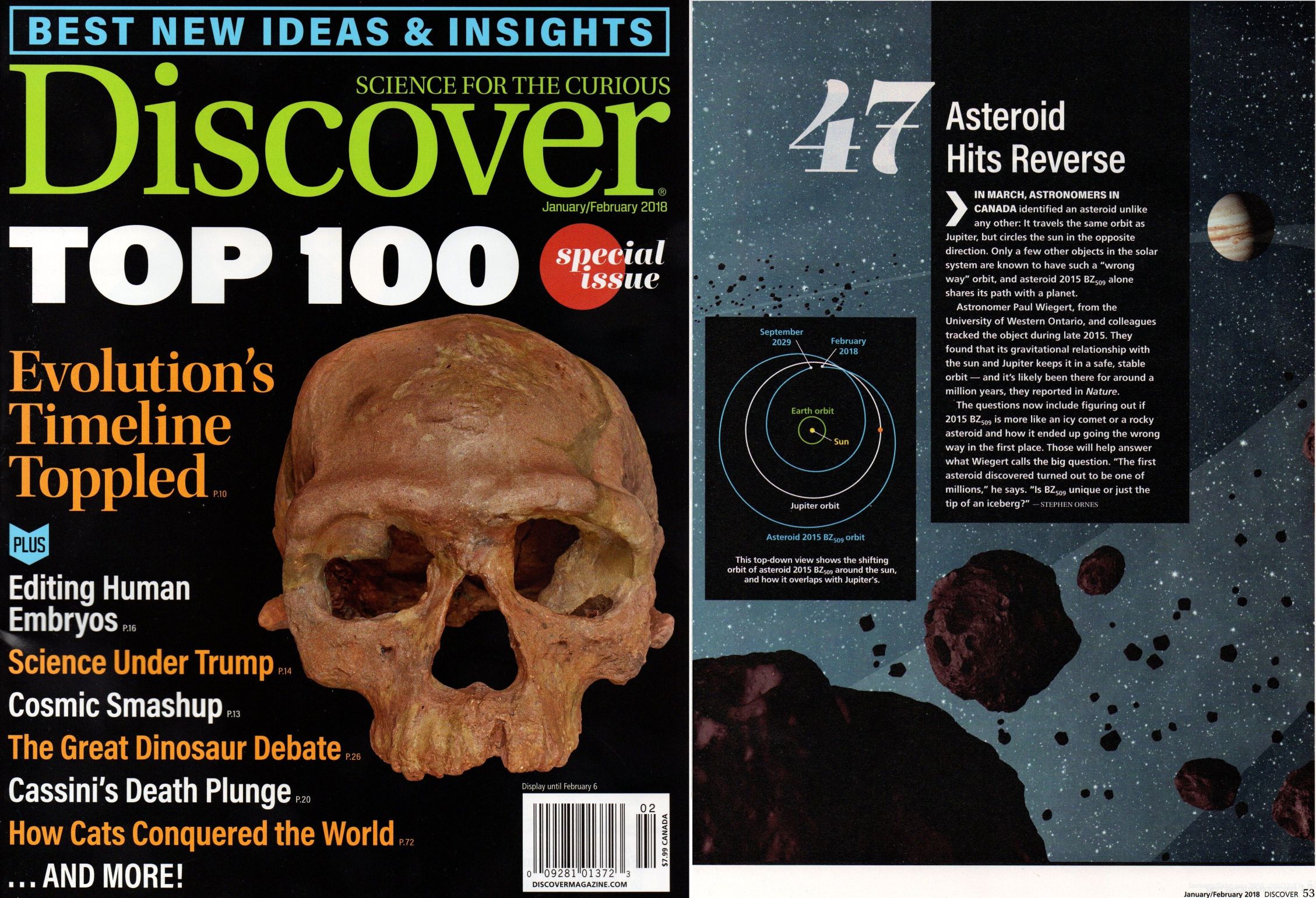
The first retrograde co-orbital asteroid(30-Mar-2017)
Asteroid 2015 BZ509 is a rare retrograde asteroid, that is it orbits the Sun in the direction opposite that of the planets and 99.99% of the other asteroids.
Stranger still, it also shares the orbital space and an important dynamical link with the
giant planet Jupiter. 2015 BZ509 is a retrograde analogue of Jupiter's Trojan asteroids,
and is discussed in the 30 March 2017 issue of Nature.
The paper made #47 on Discover magazine's Top 100 of 2017. |
|
Analysis of the Great Russian Meteor of 2013On 14 November 2013 in the journal Nature, a team of astronomers including myself present a definitive analysis of the asteroid that burned up spectacularly over the Russian city of Chelyabinsk in February 2013. To the left you see a simulated ride on the asteroid during its final approach to our planet. Click on it for more info and a bigger view. |
|
The Earth's first Trojan asteroid: 2010 TK7Canadian and French astronomers analyzed the motion of the as-yet-unnamed asteroid designated 2010 TK7, first detected by the the WISE satellite, to determine that it was the first classical Trojan asteroid of the Earth. If you would like to know more about 2010 TK7 and its motion, reported in the 28 July 2011 issue of Nature, click on the movie to the left. |
|
Other researchDetecting planets around other stars; telescopic searches for asteroids and comets; modelling the hazard to spacecraft from meteors; asteroids temporarily captured as Earth satellites. Click on the left to find out more... |